

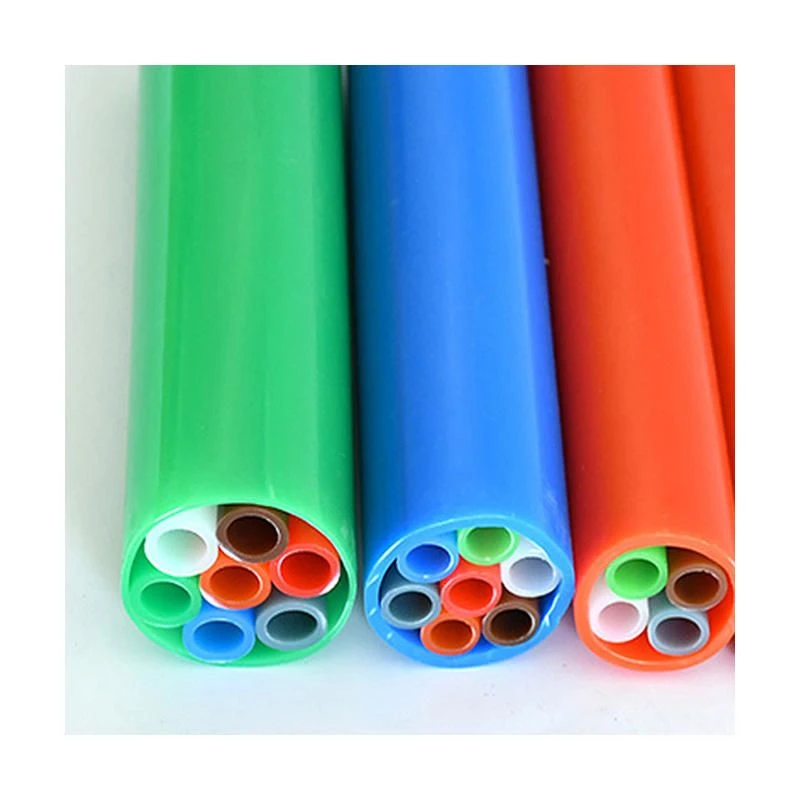
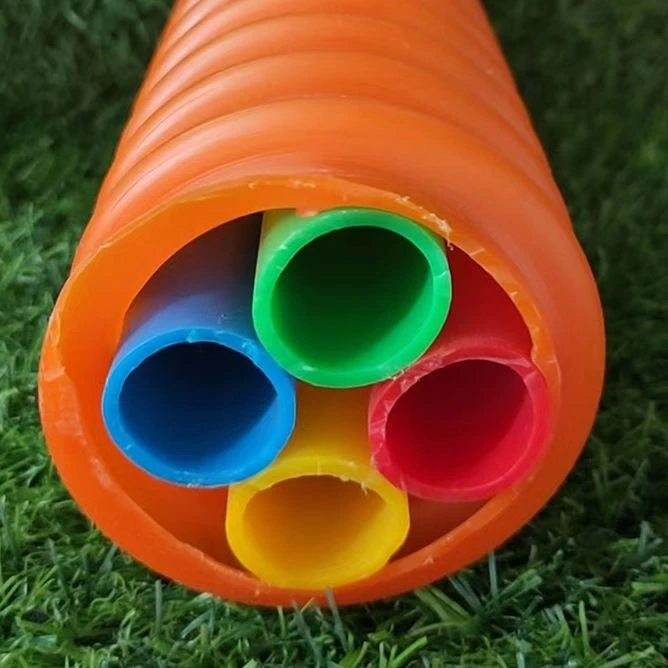


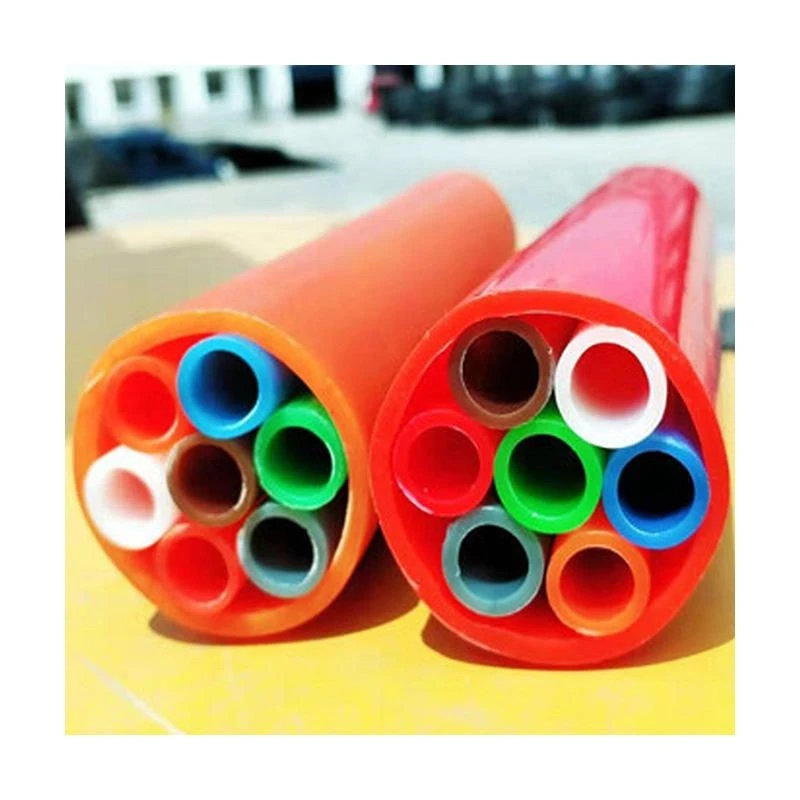
Underground Cable Pipe Hdpe Telecom Duct Pipe for Fiber Optic
PLB-HDPE Ducts are manufactured using ultra-violet (UV) stabilized grade of HDPE with required Anti Oxidant content and other recommended additives. The inner layer of ducts is duly silicon coated which minimizes the friction between OFC and the duct during the process of blowing the cable into the ducts, thus providing smooth installation of OFC in the duct without damaging the cable fibres.
HDPE PLB Duct are designed and engineered to house the sensitive nerves of Information technology i.e. optical fibers thus enabling information transfer across the globe. Available as per International Standards or Customers requirements,Most Suited for Pulling Optical Fibre Cable (OFC), Telecom, Electrical Lines etc.

Features:
Good sealing properties, chemical resistance, low construction cost
Protects and guides cable, instead of steel tube and cement tube
Strong, corrosion-resistant, high-temperature resistant
No need for cement protecting, low cost.
The inner layer silicon core is solid and permanent lubricant
The inner layer silicon core is being co-extrusion pressed into high-density polyethylene pipe , and evenly distributed throughout the pipe wall, not shed off, same lifespan with silicon tube
The inner layer silicon core and high-density polyethylene pipe have the same physical and mechanical properties;
The inner layer silicon core keeps the same friction characteristic,Cable in the pipe can be repeatedly extracted;
The inner layer silicon core does not react with water, can rinse with water after accident
Applications:
- PLB Duct Pipes are used as underground cable conduits for optical fiber cables, communication cables etc. & are suitable for cable installation by blowing tor pulling by rope techniques.
- HDPE Ducts are suitable for installation in the field dirt trenches, under sidewalks, roads, within communication networks, between communication centers and between cities. They can also be used in branch networks between cells, distribution cabinets, poles, in walls and within subterranean networks of homes, allowing the insertion of optical or copper communication cables, as well as TV/cable aluminium co-axial cables. Cables can be inserted in through the pipe by blowing, with an internal air-pressure up to eight bars.
Advantages:
1). Adopt multi-machine co-extrusion, the silicon core layer is synchronously embedded in the pipe. It will be permanent lubricated and not be stripped forever
2). The friction coefficient of the inner wall is very small. Optical cable (electric cable) can be repeatedly extracted and tension in the pipe.
3). Waterproof, damp-proof, can avoid the damage by rodent animals.
4). Aging-resistant, anti corrosion of chemicals, long service with 50 years
5). Good weather resistant ability, and its suitable temperature from -40°C to 100°C.
6). Convenient in construction, save time and the project cost
Product Paramenters
Additional Information:
Butt Fusion Joint
The most widely used method for joining individual lengths of large diameter polyethylene pipe is by heat fusion of the pipe butt ends. This technique, which precludes the need for specially modified pipe ends or couplings, produces a permanent, economical and flow-efficient connection. Field-site butt fusions may be made readily by trained operators using specially developed butt fusion machines that secure and precisely align the pipe ends for the fusion process.
The six steps involved in making a butt fusion joint are:
1.Securely fasten the components to be joined
2.Face the pipe ends
3.Align the pipe profile
4.Melt the pipe interfaces
5.Join the two profiles together
6.Hold under pressure
Characteristics:
- Environment Stress Crack Resistance (ESCR)
- Impact Resistance
- Crush Resistance
- Low Coefficient of Friction
- Temperature Resistance
- Ultraviolet (UV) protection


Hot Tags: hdpe pipes for telecommunications conduits, China hdpe pipes for telecommunications conduits manufacturers, suppliers, factory, hdpe pipe and fittings, hdpe pipe end cap, hdpe pipe flange, hdpe pipe joints, hdpe saddle fitting, hdpe water pipe


